
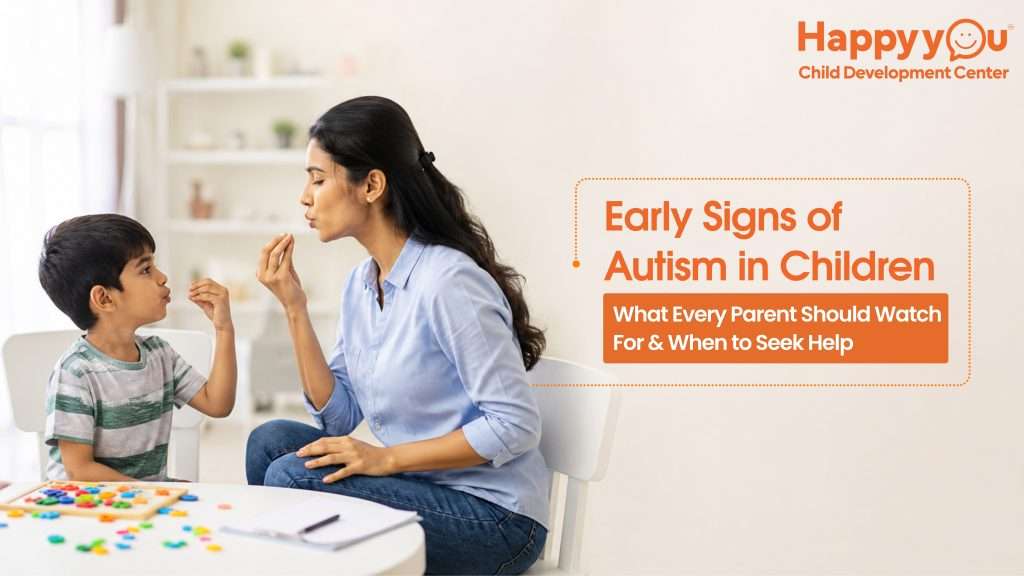
Every parent watches their child’s growth closely – the first smile, the first time they respond to their name, the first attempt to point at something they want. These small moments are how children show us they are learning to connect with the world around them.
But sometimes, parents notice that their child seems a little different from other children the same age. Maybe they don’t respond when called, avoid eye contact, prefer to play alone, or get unusually upset over small changes in routine. These observations can leave parents feeling confused, worried, and unsure of what steps to take next.
At Happyyou Child Development Centre, many parents in Nellore come to us with these very concerns. Often, they say their child is bright and curious but seems to interact with the world differently – avoiding certain sounds or textures, repeating the same actions, or struggling to connect with other children. In many cases, these are early signs of Autism Spectrum Disorder (ASD), and recognising them early can make a significant difference in a child’s development.
The good news is that autism, when identified early, can be supported effectively through therapy and guidance. Understanding the early signs, knowing what to watch for, and seeking timely help can empower parents to support their child’s growth with confidence.
What Is Autism Spectrum Disorder?
Autism Spectrum Disorder is a developmental condition that affects how a child communicates, interacts socially, and behaves. It is called a “spectrum” because it looks different in every child – some children may have mild difficulties with social interaction, while others may face more significant challenges with communication and behaviour.
Autism is not caused by parenting style, and it is not something a child will simply “grow out of.” It is a lifelong developmental difference, but with early identification and the right support, children with autism can build strong communication skills, form meaningful relationships, and lead fulfilling lives.
Every child on the spectrum is unique, which is why early assessment and personalised therapy are so important in helping each child reach their full potential.
Why Early Detection Matters?
The early years of a child’s life are a critical window for brain development. During this time, the brain is highly responsive to therapy and learning, which means that early intervention can have a significant, lasting impact on a child’s communication, social, and behavioural skills.
When signs of autism go unnoticed or unaddressed, children may struggle more with communication, social interactions, and adapting to school environments as they grow older. This can affect their confidence and independence over time.
Recognising the signs early allows families to access therapy and support during this crucial developmental window – giving children the best possible opportunity to build the skills they need for a confident future.
Early Signs of Autism Parents Should Watch For
Every child develops at their own pace, and not every unusual behaviour indicates autism. However, if a child shows several of the following signs consistently, it may be worth seeking a professional opinion.
Social and Communication Signs
- Limited or no eye contact
- Not responding to their name by 12 months
- Delayed speech or not speaking at all by age two
- Difficulty understanding or using gestures, such as pointing or waving
- Little interest in interacting with other children
- Difficulty understanding others’ emotions or facial expressions
- Preferring to play alone rather than with others
Behavioural Signs
- Repetitive movements, such as hand-flapping, rocking, or spinning
- Intense focus on specific objects or topics
- Strong resistance to changes in routine
- Repeating words or phrases (echolalia) without clear communicative intent
- Lining up toys or objects in a particular order
- Unusual reactions to sounds, lights, textures, or smells
Developmental Signs
- Delayed milestones in speech, gestures, or social interaction
- Loss of previously acquired language or social skills
- Difficulty with imaginative or pretend play
- Difficulty adjusting to new environments or social settings
It is important to remember that occasionally showing one of these signs does not necessarily mean a child has autism. However, if several signs appear together or continue over time, a professional developmental assessment can help provide clarity.
When Should Parents Seek Professional Help?
Parents often wonder how to tell the difference between normal developmental variation and a sign that requires attention. As a general guide, it may help to consult a specialist if a child:
- Does not babble or make sounds by 12 months
- Does not use gestures, such as pointing or waving, by 12 months
- Does not say single words by 16 months
- Does not combine two words by 24 months
- Loses language or social skills they previously had, at any age
- Shows limited interest in interacting with family members or other children
Early assessment does not necessarily mean a diagnosis – it simply provides a clearer picture of a child’s development and the kind of support that may help them thrive.
How Therapy Supports Children with Autism?
With the right therapy, children with autism can build meaningful communication, social, and behavioural skills. At Happyyou Child Development Centre, therapy is tailored to each child’s specific needs and may include:
Speech and Language Therapy
Helping children develop communication skills, from first words to full sentences.
Behavioural Therapy
Supporting children in managing emotions, reducing challenging behaviours, and building adaptive skills.
Social Skills Training
Helping children learn to interact, share, and build friendships with peers.
Sensory Integration Therapy
Supporting children who are sensitive to sounds, textures, lights, or movement.
Occupational Therapy
Building fine motor skills and independence in daily routines.
Through consistent, personalised therapy and family involvement, many children on the autism spectrum show meaningful progress in communication, behaviour, and social confidence over time.
What Happens During an Autism Assessment at Happyyou Child Development Centre?
Many parents feel anxious about the idea of an autism assessment, but at Happyyou Child Development Centre, the process is designed to be supportive and reassuring rather than clinical or intimidating.
During the assessment, our team observes how a child communicates, plays, and interacts, while also discussing developmental history and concerns with parents. Based on this, we recommend a personalised therapy plan suited to the child’s specific strengths and challenges – helping families understand the road ahead with clarity and confidence.
Why Parents Choose Happyyou Child Development Centre in Nellore?
Receiving early guidance on a child’s development can feel overwhelming, especially when it comes to something as significant as autism. Parents want a centre that treats their child with patience, understanding, and genuine care.
At Happyyou Child Development Centre in Nellore, we are committed to supporting every child’s unique developmental journey with compassion and expertise.
Parents choose Happyyou Child Development Centre because of:
Thorough, Compassionate Assessments
We take time to understand each child individually, ensuring families receive clear, honest guidance rather than rushed conclusions.
Experienced, Multi-Disciplinary Team
Our speech therapists, behavioural therapists, and developmental specialists work together to support every aspect of a child’s growth.
Family Involvement and Guidance
We equip parents with practical strategies to support their child’s progress at home, not just during therapy sessions.
Engaging, Child-Friendly Sessions
Therapy is designed around play and positive interaction, helping children feel comfortable and motivated to participate.
Ongoing Progress Monitoring
We track each child’s development closely and keep parents informed, ensuring therapy remains effective and goal-focused.
At Happyyou Child Development Centre, families receive comprehensive developmental support under one roof, making the journey easier to navigate.
Frequently Asked Questions (FAQs) About Early Signs of Autism in Children
1. At what age can autism be identified in children?
Signs of autism can often be noticed as early as 12 to 18 months, though some children may show clearer signs closer to age two or three. Early developmental screening can help identify concerns sooner.
2. Does every child with delayed speech have autism?
No. Speech delay can occur for many reasons and does not automatically indicate autism. However, if speech delay is accompanied by other signs, such as limited eye contact or repetitive behaviours, a professional assessment can help clarify the cause.
3. Can autism be cured?
Autism is a lifelong developmental difference rather than a condition that is “cured.” However, with early therapy and consistent support, many children develop strong communication, social, and behavioural skills that help them thrive.
4. What should I do if I notice signs of autism in my child?
If you notice several signs consistently, it is a good idea to consult a developmental specialist for a professional assessment. Early evaluation can provide clarity and guide your next steps.
5. How long does autism therapy usually take?
There is no fixed duration – it depends on the child’s individual needs, age, and progress over time. Many families see meaningful improvement with consistent, long-term therapy and support.
Supporting Every Child’s Journey with Understanding
Every child deserves the chance to be understood, supported, and given the tools to communicate and connect with the world around them. While noticing signs of autism in your child can feel worrying, early awareness and the right support can make a profound difference in their development.
At Happyyou Child Development Centre, we are dedicated to helping children in Nellore build confidence, communication skills, and independence through compassionate, evidence-based therapy – while walking alongside parents every step of the way.
If you have noticed signs of autism in your child, don’t wait to seek guidance. Early intervention can open the door to meaningful progress and a more confident future for your child.
Let’s Talk
Take the first step toward understanding your child’s developmental journey.
Call: 8142999996
Website: https://happyyou247.com/happyyou-child-development-centre/